
India Dual Citizenship: Guide for UK Citizens & OCI
India does not permit dual citizenship for most adults. This guide for UK citizens explains Indian citizenship rules, the OCI card benefits, and what it means for your British…

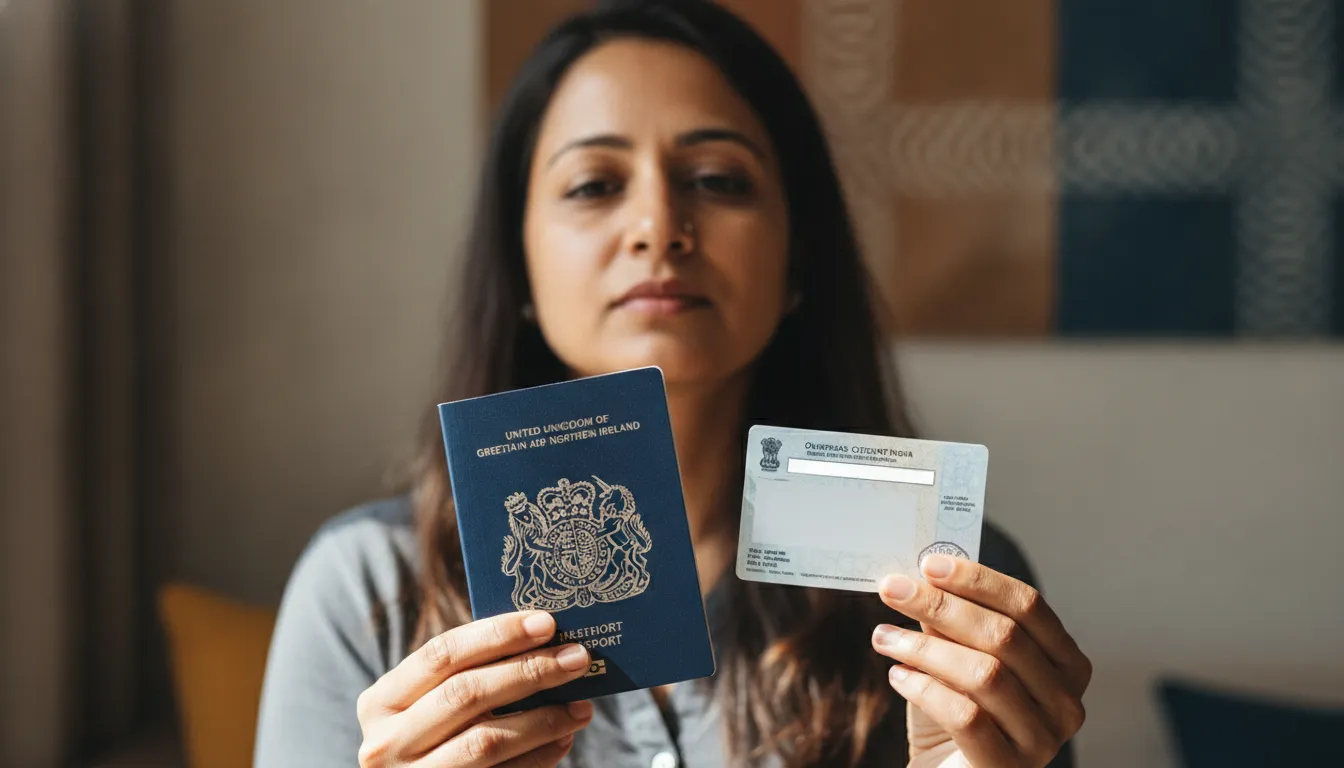
TL;DR: For most adults, India does not allow dual citizenship. This means if you are a British citizen and want to become Indian citizen, you will likely need to give up your British nationality. The Overseas Citizen of India (OCI) card is an alternative that offers a lifelong visa and other OCI card benefits India, but it is not citizenship and does not grant an Indian passport after foreign citizenship or voting rights. Regaining Indian citizenship rules after renouncing it depends on your specific situation and is not automatic.
Many British citizens have strong ties to India, whether through family, work, or heritage, often splitting their time and managing affairs across both countries. Staying connected and managing your life when living abroad often depends on your legal status in both places, including your citizenship. Imagine trying to keep your home phone number working abroad or dealing with banking if your citizenship status is unclear – it can cause real headaches. This guide helps UK citizens understand the dual citizenship India rules, especially what it means for your British citizenship India, and the role of the Overseas Citizen of India OCI status.

Can adults have dual citizenship in India?
No, most adults cannot have dual citizenship in India. India’s law does not generally permit an adult to be a citizen of India and another country at the same time, unlike the UK which allows multiple nationalities. If an Indian citizen freely chooses to get citizenship in another country, they will usually stop being an Indian citizen under Section 9 of the Citizenship Act, 1955 Ministry of Home Affairs.
There are two situations that people sometimes confuse with actual dual citizenship India:
- Children with citizenship from birth and another country: Indian law has special rules for children who become Indian citizens because of their parents (by descent) and also have citizenship of another country. Section 4 of the Citizenship Act covers this, and specific rules apply when these children become adults (reach 18 years old).
- Holding an OCI card: An Overseas Citizen of India OCI cardholder is seen as a foreign national, not an Indian citizen. While the OCI card India provides a lifelong visa and other privileges, it does not give the right to an Indian passport or political rights, like voting OCI.
So, even if you were born in India, have Indian parents, or hold an OCI card India, it does not mean you can hold both Indian and foreign citizenship forever.

What happens if a British citizen applies for Indian citizenship?
The UK allows its citizens to hold another nationality, meaning you can have British citizenship India at the same time as another country’s citizenship, as confirmed by GOV.UK. However, this rule in the UK does not change India’s stance against dual citizenship India. If your application to become Indian citizen is approved, you will likely need to renounce British citizenship or any other foreign nationality you hold as part of the process.
For certain ways to become Indian citizen, the Citizenship Rules, 2009, require applicants to agree to give up their existing foreign citizenship if their application is successful Ministry of Home Affairs. Giving up your British citizenship is a serious decision that can affect your right to live in the UK. Therefore, you should think carefully about renouncing your citizenship and not treat it as just a simple step, as advised by GOV.UK.
What is an OCI card and its benefits?
An Overseas Citizen of India OCI card is a special status offered to certain foreign nationals who have a close connection to India. It’s important to understand that holding an OCI card India does not make you an Indian citizen. Instead, it provides specific OCI card benefits India that make it easier for people with Indian heritage to visit and live in India.
Common groups of people who can get an OCI card India include:
- Someone who used to be an Indian citizen but now has citizenship of another country.
- A person who would have been able to become Indian citizen when the Indian Constitution started on January 26, 1950.
- Someone whose family comes from an area that became part of India after August 15, 1947.
- A child, grandchild, or great-grandchild of anyone in the eligible categories above.
- Some minor children whose parents are eligible or are Indian citizens.
- A foreign spouse of an Indian citizen or OCI card India holder, if their marriage has been officially registered and lasted for at least two years, and after a security check.
However, there are also rules about who cannot get an OCI card India. For example, people with connections to Pakistan, Bangladesh, or other countries specified by the Indian government might not be eligible. Always check the most up-to-date eligibility rules directly from official sources to make sure you qualify, rather than just relying on your family history OCI.
How does OCI compare with Indian citizenship?
It’s crucial to understand that an Overseas Citizen of India OCI card is not the same as being an Indian citizen. While an OCI card India offers many benefits, it does not give you all the rights and duties of full citizenship. The table below highlights the key differences:
| Question | Indian Citizen | OCI Cardholder |
|---|---|---|
| Is it citizenship? | Yes | No. An OCI cardholder stays a foreign national. |
| Passport | Can hold an Indian passport | Cannot get a regular Indian passport after foreign citizenship based on OCI. |
| Entry to India | Uses an Indian passport | Usually uses the OCI card India with a valid foreign passport. |
| Long-term stay | Controlled by citizenship rights | Lifelong multiple-entry visa, as long as scheme rules are followed. |
| Voting | Can vote if they meet other requirements | Cannot vote in Indian elections. |
| Public office and services | Can hold public office and services under Indian law | Generally not allowed for OCI cardholders. |
| Land and property | Subject to Indian law | There are limits, especially on agricultural land, farmhouses, and plantation property. |
The Indian government’s FAQ on Overseas Citizen of India OCI cards states that the card means you are a foreign national with a lifelong visa that lets you enter India multiple times OCI. It also lists activities that need special permission, such as doing research, working as a journalist, missionary work, mountain climbing, or visiting protected or restricted areas.
An OCI card India can make it simpler to keep family, work, or study ties with India, but it does not give all the rights of an Indian citizen. Specifically, it does not provide an Indian passport after foreign citizenship, the right to vote, or a general way to get into Indian public services. For British citizens, this means you can maintain your connection to India without losing your original nationality, which can be useful if you need to keep your UK phone number working abroad for banking or other essential services. If you ever need to handle your phone number across borders, you might find useful information in a UK guide on keeping your UK number abroad.
How do you apply for an OCI card?
To apply for OCI, you typically submit your application online. The process requires specific documents to prove your identity, current citizenship, and your connection to India. The exact paperwork can vary depending on your situation.
Generally, you will need:
- A valid foreign passport, such as your British passport.
- Proof that you are a citizen of your current country.
- Documents that show your link to India, like birth certificates, marriage certificates, or old Indian passports.
- If you are a former Indian citizen, you will need your cancelled Indian passport and a surrender certificate.
The documents needed depend on whether your claim to an Overseas Citizen of India OCI card is based on your own past citizenship, that of a parent or grandparent, or through your spouse OCI. The application process may also include checking your documents and providing fingerprints or other biometric data. If you are applying from the UK, always follow the specific instructions from the Indian mission or the official OCI service for that region, as requirements can change.
Can you get Indian citizenship back after renouncing it?
There is no automatic right to regain Indian citizenship just because you were born in India, used to have an Indian passport, or later decide you want to return. The way you might be able to get your citizenship back depends on how you lost it and your current situation. The Citizenship Act, 1955, offers a specific path for certain minor children to resume citizenship, while different registration methods might be available for adults who were formerly citizens Ministry of Home Affairs.
Resumption after a parent’s renunciation
If a parent gives up their Indian citizenship, their minor child might also lose Indian citizenship under Section 8(2) of the Citizenship Act. However, this child can make a formal declaration to regain Indian citizenship within one year of becoming an adult (reaching 18 years old). They must follow the set procedure and take an oath Ministry of Home Affairs.
The Citizenship Rules refer to this declaration as Form XXV, and the certificate confirming citizenship is Form XXVI Ministry of Home Affairs. This rule specifically applies to children who lost their citizenship because a parent renounced Indian citizenship, not to adults who gave up their own citizenship.
Registration as an adult former citizen
An adult who previously held Indian citizenship may need to explore getting registered under Section 5 of the Citizenship Act, rather than simply applying to “reclaim” it. The Act includes a category for people who, or whose parents, were citizens of independent India before and have lived in India for the required 12 months right before they apply Ministry of Home Affairs. This path is for those seeking to regain Indian citizenship.
However, the Act also states that a person who has renounced Indian citizenship, had it taken away, or lost it in another way, cannot be registered under Section 5(1) unless the Central Government orders it. This means that getting registered is not an automatic right and depends on the details of each person’s case. The Citizenship Rules also require you to promise to give up your foreign citizenship if your application is approved Ministry of Home Affairs.
In simple terms, you should not assume that you can regain Indian citizenship while also keeping your British passport. You will likely face the same rules as someone trying to become Indian citizen for the first time. Navigating these rules can be complex, and understanding your options for maintaining connections, like setting up banking or keeping a reliable phone number, is key whether you are in Australia or elsewhere.
Registration through OCI
An adult who holds an Overseas Citizen of India OCI card can apply for Indian citizenship under Section 5(1)(g) after being registered as an OCI cardholder for at least five years. They must also have lived in India for the 12 months immediately before applying. The Citizenship Act allows for a small exception to the 12-month residence rule in special cases, but this is not guaranteed Ministry of Home Affairs.
This path through OCI card India still leads to full Indian citizenship, not dual citizenship India. The Citizenship Rules require you to agree to give up your foreign citizenship if your application is successful Ministry of Home Affairs. Therefore, while an OCI card can be a step towards becoming an Indian citizen, it does not allow you to keep your existing foreign nationality.

How can you become an Indian citizen?
The right way to become Indian citizen depends entirely on your personal situation. There are several different paths to citizenship, which include citizenship by birth, by descent, by registration, and by naturalisation Ministry of Home Affairs. Each route has its own set of Indian citizenship rules and requirements.
Generally, you might need to consider:
- Citizenship by birth or descent: This depends on where and when you were born, the citizenship status of your parents, and whether any necessary consular registration was completed (for example, if you were born outside India to Indian parents).
- Registration: This category covers various groups, such as people of Indian origin, spouses of Indian citizens, certain children, former citizens looking to regain Indian citizenship, and Overseas Citizen of India OCI cardholders. The requirements for living in India and other conditions vary greatly depending on which specific category you fall into.
- Naturalisation: The Central Government can grant citizenship to an adult who meets the conditions listed in the Third Schedule of the Citizenship Act and completes the required process. The conditions for naturalisation include promising to renounce Indian citizenship (or any other foreign citizenship) if the application is approved, taking an oath of loyalty, and providing proof of good character and language knowledge Ministry of Home Affairs.
For naturalisation, a common residence rule states that you must have lived in India for the entire 12 months immediately before applying. Additionally, you must have lived in India or worked for the Indian government for specific periods during the 14 years leading up to your application. The exact requirements can change, so always check the latest forms and Indian citizenship rules.
For individuals managing finances or seeking property abroad while considering new citizenship, understanding local banking and property rules is vital. For example, if you’re looking into buying property in another country, insights from guides like buying property in Australia as a foreigner can be very helpful.
What documents do you need to apply for Indian citizenship?
When you apply for OCI or become Indian citizen, the documents you need will vary based on the specific citizenship route you are taking. It’s important to gather all necessary paperwork carefully.
You could be asked to provide:
- Your current foreign passport and proof of your nationality, for instance, your British passport.
- Any previous Indian passport, citizenship papers, or birth records.
- Birth certificates that show your connection to an Indian parent or grandparent.
- Residence permits and evidence showing how long you have spent living in India.
- Marriage or family documents, if your application is based on being married to an Indian citizen or being related to one.
- Proof of your language skills or good character, if applying through naturalisation.
- A surrender or renunciation certificate, if you previously renounced Indian citizenship or another nationality.
- Affidavits, photographs, biometric information (like fingerprints), and an oath of loyalty Ministry of Home Affairs.
The official application form and the specific Indian mission or district office handling your case will provide the final and complete list of required documents. Do not send original documents until the authority receiving them has told you exactly how they will be checked and verified. This advice is critical to avoid issues, much like how understanding local nuances is key when opening a bank account in a new country, such as knowing the process for banking in Thailand for expats.
What happens to your Indian passport after acquiring another citizenship?
If you obtain citizenship of another country, you should not continue to use your Indian passport after foreign citizenship as if you were still an Indian citizen. Indian citizenship generally ends when a person willingly gains another country’s citizenship. Once a declaration to renounce Indian citizenship is officially registered, that person stops being an Indian citizen Ministry of Home Affairs.
The steps involved in managing your passport and citizenship documents are separate from any application you might make later for an Overseas Citizen of India OCI card. If you are unsure whether you need a surrender certificate for your Indian passport, you should contact the relevant Indian mission or Passport Seva office. Always keep careful records of all the documents you submit.
If you travel to India as a British citizen without Indian citizenship, you will need the correct visa, unless you hold a valid OCI card India. OCI cardholders can travel with their OCI card and a valid British passport without needing a separate visa. All other travelers should check the specific visa requirements that apply to them before making travel plans, as specified by GOV.UK.
FAQs on dual citizenship in India as a British citizen
These are some common questions British citizens have about dual citizenship India and Indian citizenship rules.
Is an OCI card the same as dual citizenship?
No, an Overseas Citizen of India OCI card is not the same as dual citizenship India. An OCI cardholder is considered a foreign national by India. While an OCI card India provides a lifelong, multiple-entry visa and certain benefits, it does not give you an Indian passport after foreign citizenship, the right to vote, or all the other rights that an Indian citizen enjoys OCI.
Can I keep British citizenship and become an Indian citizen?
Generally, no. The UK permits its citizens to hold other nationalities, allowing for British citizenship India alongside other citizenships. However, India’s Indian citizenship rules typically require a person who becomes an Indian citizen to renounce British citizenship or any other foreign citizenship they hold. You should always confirm your specific situation with the Indian authorities before making any decisions about your citizenship Ministry of Home Affairs GOV.UK.
Can I get Indian citizenship back after renouncing it?
It might be possible to regain Indian citizenship after renouncing it, but it is not an automatic process. A minor child who lost Indian citizenship because their parent gave it up may have a specific way to resume citizenship within one year of becoming an adult. An adult who was previously an Indian citizen might need to apply for Indian citizenship again through registration under Section 5 of the Citizenship Act, which has its own strict conditions Ministry of Home Affairs.
Does OCI let me vote in India?
No, holding an Overseas Citizen of India OCI card does not give you the right to vote in Indian elections. OCI cardholders also cannot hold constitutional positions or public service jobs that are specifically reserved for Indian citizens OCI.
Can OCI cardholders buy property in India?
OCI cardholders are generally treated like non-resident Indians for some property dealings in India. However, there are restrictions on the types of property they can buy. For instance, agricultural land, farmhouses, and plantation property are specifically excluded under the OCI rules OCI. If you are thinking about buying property in India, it is important to check the specific rules that apply to your situation and get expert advice. Understanding property laws is crucial for any international move, similar to researching how to buy a summer house in Denmark after Brexit.
Can a child hold Indian and British citizenship?
Whether a child can hold both Indian and British citizenship depends on how they obtained each nationality and if all the necessary requirements were met. Indian law includes a period of six months after a child becomes an adult (reaches 18 years old) during which they must choose between their Indian citizenship and any other citizenship they hold. If they do not give up their other citizenship within this time, their Indian citizenship may end Ministry of Home Affairs. It is very important to get legal advice before a child applies for or travels on another passport to avoid any unintended loss of citizenship.
Key takeaways
- India does not officially recognize dual citizenship India for adults. This means an Indian citizen will automatically lose their Indian citizenship if they willingly get citizenship in another country.
- British citizens who want to become Indian citizen are usually required to promise that they will renounce British citizenship if their application is approved.
- Holding an Overseas Citizen of India OCI card gives you a lifelong, multiple-entry visa and special OCI card benefits India. However, OCI cardholders remain foreign nationals and do not have voting rights or access to an Indian passport after foreign citizenship.
- Regain Indian citizenship after giving it up is not automatic. The process depends on the specific way you lost citizenship and your current personal situation.
Related reading
Sources
| # | Source | Website |
|---|---|---|
| 1 | Ministry of Home Affairs | mha.gov.in |
| 2 | OCI | ociservices.gov.in |
| 3 | GOV.UK | gov.uk |
| 4 | Ministry of Home Affairs | mha.gov.in |
| 5 | GOV.UK | gov.uk |
| 6 | GOV.UK | gov.uk |